
The calisthenics corner of social media is a wild place. For every piece of solid training advice, there are a dozen videos promising planche mastery in six months or claiming that one weird trick will unlock skills overnight. With over 14 years of training experience and my medical background, I have made it my mission to separate fact from fiction. In a wide-ranging reaction video, I dissect tips from various influencers, celebrating the genuinely helpful advice and dismantling the misinformation with equal energy. The results are entertaining, occasionally brutal, and packed with practical training wisdom.
The Six-Month Planche Promise
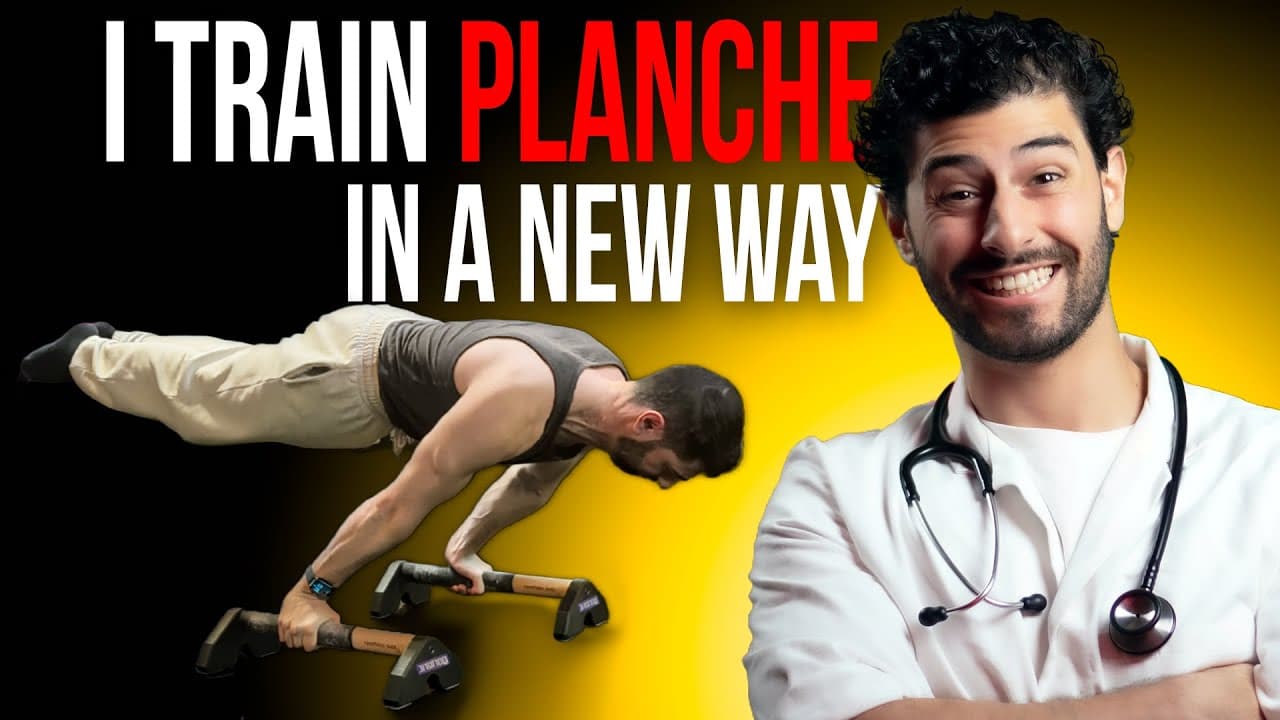
One of the most persistent myths in calisthenics is the idea that the planche has a fixed timeline. I react to an influencer who claims to have unlocked the planche in six and a half months "from nothing," proceeding to offer a step-by-step guide for others to do the same. The problem begins immediately: the influencer's demonstration does not show a clean progression from zero, and the advice implicitly suggests that six months is a reasonable expectation for everyone.
My response is emphatic. Individual timelines for skill acquisition vary enormously based on body weight, height, limb proportions, training background, and genetic factors. When an influencer presents their personal timeline as a universal benchmark, it sets beginners up for frustration and potentially dangerous overreach. Athletes who expect a planche in six months may push beyond safe training loads to meet that arbitrary deadline.
The specific programming advice in the video compounds the problem. The influencer suggests doing planche leans every day from the outset, then later recommends at least four sessions per week. For a complete beginner, daily planche leans represent a significant overload on the wrists, shoulders, and biceps tendons, tissues that require gradual adaptation. I point out the inconsistency and the injury risk inherent in such aggressive programming for novices.
The Straddle Planche Controversy
One area where I partially agree with the same influencer is the recommendation to skip the straddle planche progression. The conventional wisdom in calisthenics has always been to progress from tuck to advanced tuck to straddle to full planche. But I break down why the straddle planche is actually more technically demanding than the full planche, even though it requires less raw strength.
The biomechanical explanation is straightforward. When the legs spread in a straddle position, the body has a natural tendency to arch the lower back. This arch cascades upward, causing loss of protraction in the upper back. The result is a technically compromised position that can actually reinforce bad habits. Many athletes find that they can hold a full planche with a band more easily than a clean straddle planche, precisely because the full planche position is simpler from a coordination standpoint.
I recommend that most athletes, especially those under 190 centimeters in height, skip the straddle planche and go directly to banded full planche work. The principle at play is specificity: if the goal is a full planche, training should be as specific to that position as possible.
The Perfect Explosive Pull-Up Tutorial
Not all my reactions are critical. I came across a tutorial on explosive pull-ups that earned my genuine praise. The video, created by an athlete named Timmy, emphasizes three key points that align perfectly with sports science principles.
First, the tutorial focuses on pulling with elbows in front of the body rather than flared to the sides. I explain the biomechanical reasoning: with elbows forward, the shoulder can move into extension behind the body, allowing for a much higher pull. With elbows flared, the range of motion is physically limited by the torso. Anyone who performs extremely explosive pull-ups, myself included, naturally adopts this elbow position.
Second, the tutorial emphasizes long rest periods between sets. This is critical for power training, which relies on the nervous system being fully recovered between efforts. Explosivity is not about grinding through fatigue; it is about maximum recruitment in a rested state.
Third, and most impressively, the tutorial advises stopping a set the moment speed decreases. This principle comes directly from sports science literature on power training. When bar speed or movement speed drops, the athlete is no longer training power but instead training strength-endurance. The stimulus has shifted, and the training effect is different from the intended goal. I have to say, this level of specificity in a social media tutorial is rare and commendable.
The EMG Study Trap
In a reaction to a pull-up versus chin-up comparison, I encounter one of my biggest pet peeves in fitness content: the misuse of EMG (electromyography) studies. The video in question cites EMG data showing greater bicep activation during chin-ups to argue that chin-ups are superior for bicep growth.
I break down why this reasoning is flawed on multiple levels. EMG measures electrical activity in muscles via surface sensors, but these sensors also pick up signals from surrounding muscles and nerves, making isolation difficult. The signal is not standardized across individuals, equipment, or anatomical variations. More fundamentally, higher electrical activity does not necessarily equate to greater mechanical tension, which is the primary driver of muscle hypertrophy.
The correct approach, as I argue, is to analyze the biomechanics of a movement rather than relying on EMG data. Mechanical tension, determined by the moment arm and force application through a specific range of motion, is what actually determines how much a muscle grows. EMG studies are useful research tools but are far too often oversimplified in fitness content to make claims they cannot support.
The One-Arm Pull-Up Band Trick
In a refreshing moment of humility, I have to admit I learned something entirely new from a social media tip. The standard approach to banded one-arm pull-up training involves placing the band on one side of the bar and the hand on the other. While this builds pulling strength, it lacks specificity because the resistance profile does not match the actual one-arm pull-up movement.
The tip suggests placing the band in the middle of the bar with a slight gap, then positioning the hand between the two sides of the band. This creates a pulling path that is far more specific to the actual one-arm pull-up. Despite training for 14 years and being proficient at one-arm pull-ups, I had never seen this technique and immediately recognized its value.
The Bent-Elbow Planche Debate
A more controversial tip involves slightly bending the elbows during planche training. The comments section was hostile, but I offer a more measured assessment. For athletes with hyperextended elbows, a slight bend can provide a safer training position. Even for athletes with straight elbows, bent-arm planche holds can serve as a useful supplementary exercise that builds strength through an additional range of motion.
The key distinction is that this should not replace straight-arm planche training but rather complement it. If an athlete can hold a straight-arm planche but struggles with a slightly bent-arm variant, that discrepancy indicates a strength gap worth addressing. I recommend perhaps one or two sets as supplementary work, not a wholesale change in training approach.
Key Takeaways
- •Never trust fixed timelines for skill acquisition; individual variation in body type, training history, and genetics makes universal predictions meaningless
- •The straddle planche is more technically demanding than the full planche; most athletes should skip it in favor of banded full planche work
- •For explosive pull-ups, keep elbows in front, use long rest periods, and stop sets when speed decreases
- •Be skeptical of claims based on EMG studies; mechanical tension from biomechanical analysis is a more reliable indicator of muscle growth stimulus
- •Training specificity matters enormously; even small changes to band placement during one-arm pull-up training can significantly improve transfer
- •Supplementary exercises like bent-arm planche holds have their place when used to address specific strength gaps
The calisthenics community thrives when athletes with real expertise hold content creators accountable. My reaction format serves a genuine educational purpose: it teaches viewers not just what to do, but how to critically evaluate the advice they encounter online. In a landscape flooded with content, that critical thinking skill may be the most valuable takeaway of all.