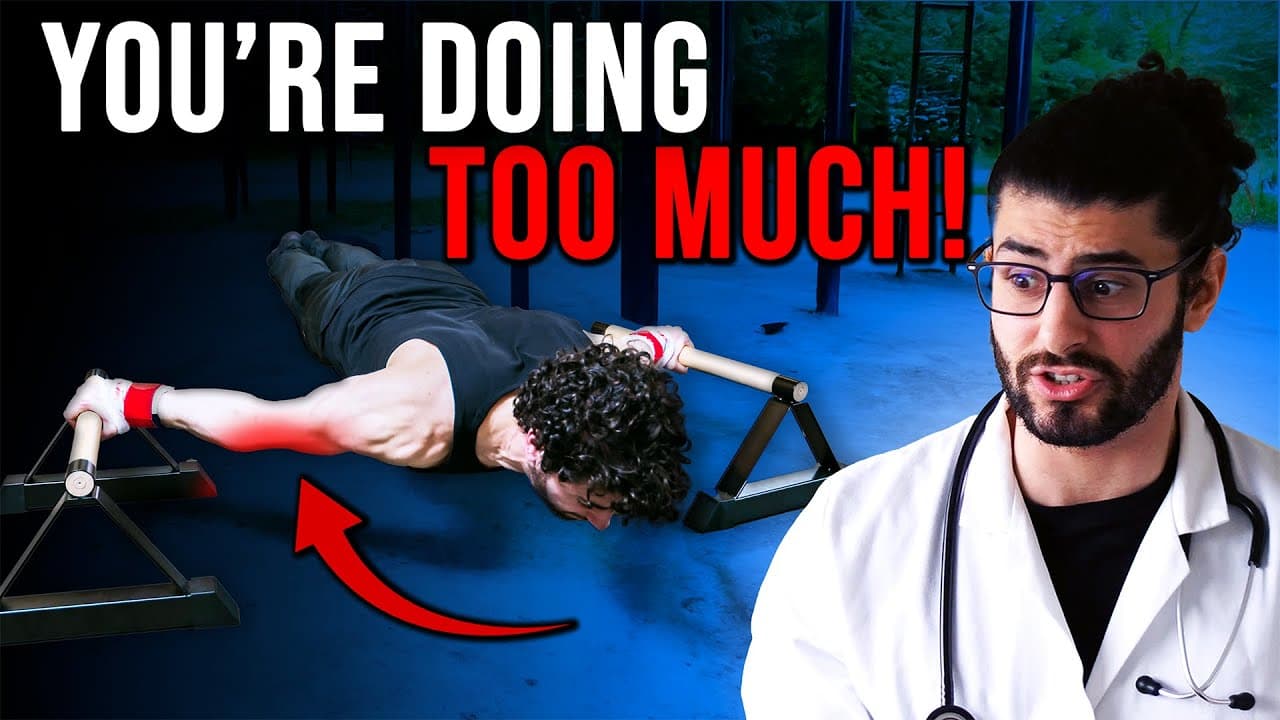

Some of the strongest calisthenics athletes on the planet today are not adults. They are 14, 12, and in one jaw-dropping case, 8 years old. These are not children doing pull-ups at a playground. They are holding maltese positions, performing one-arm planches, and repping out weighted muscle-ups at levels that make seasoned veterans question their own training careers. As a medical doctor with over 15 years of calisthenics experience, I recently dove into this phenomenon by reacting to some of the most impressive young athletes on social media, and the results left me feeling humbled, and I have held a full planche and a floor maltese.
The Kids Who Broke the Internet
The showcase begins with Jonah Calisthenics, a 15-year-old who has essentially completed the calisthenics skill tree. Maltese hold, maltese press, full planche with perfect protraction: Jonah does all of it with the casual confidence of someone who has been in the game for decades. In reality, he has been training for six years, started with hand balancing, and trains six to seven times per week. He unlocked the planche in 2023 and within three years progressed to attempting the world record one-arm planche, holding it for over 30 seconds in full planche position. To put that in perspective, a five-second one-arm planche is already considered extraordinary at any age.
Then there is Ethi, a 16-year-old who unlocked the legendary 5-5-5 sequence after just 16 months of training. He went from tuck planche to full planche in two months. Two months. I have been training for nearly 15 years and have never achieved some of the skills this teenager performed within his first year and a half.
Perhaps the most astonishing case is Emmy Chan, who at 8 years old was filmed performing multiple reps of weighted muscle-ups. My reaction to this clip involved grabbing a stethoscope, genuinely concerned about my own heart rate. The gap between what these children are achieving and what was considered possible at their age even five years ago is staggering.
Why This Is Happening: The Science
The first and most obvious factor is biomechanics. Calisthenics is a sport governed by leverage, and leverage is dictated by body dimensions. A child who weighs 40 kilograms with proportionally shorter limbs faces a fraction of the torque demands that an 80-kilogram adult must overcome. Every leverage-based skill, from front lever to planche to maltese, becomes mechanically easier with a smaller, lighter frame. This is the same principle that makes elite gymnasts predominantly compact in stature.
I note a telling phenomenon: young gymnasts often achieve full planches at early ages, then lose the ability during puberty as they grow taller and heavier. The skill does not disappear because they forgot how to do it. It disappears because the physics changed. Their body grew, the lever arms lengthened, and the force requirements skyrocketed.
The Neuroplasticity Advantage
Beyond physics, children possess a neurological superpower: their brains are wired for rapid learning. Neuroplasticity, the brain's ability to form and reorganize neural connections, is dramatically higher in children and adolescents than in adults. This means a young athlete can go from terrible form to efficient movement patterns in days, while an adult working on the same skill might need months of repetition to achieve comparable motor learning.
This explains the seemingly impossible timelines. Two months from tuck to full planche sounds absurd for an adult, but a neurologically primed teenager with favorable body proportions and no injury history is operating with fundamentally different biological hardware. Their nervous system is not better in absolute terms; it is simply faster at acquiring new motor skills.
Recovery: The Unfair Advantage
From a medical standpoint, I emphasize that children recover from training stress significantly faster than adults. Their connective tissues are more resilient, their inflammatory responses resolve more quickly, and perhaps most importantly, they have not yet accumulated the chronic injuries that limit adult athletes. A 30-year-old calisthenics practitioner is almost certainly managing at least one nagging issue. A 12-year-old walks into training with joints, tendons, and ligaments that have never been seriously stressed.
This recovery advantage compounds over time. Faster recovery allows higher training frequency. Higher training frequency accelerates skill acquisition. Accelerated skill acquisition builds confidence and motivation, which drives even more training. It is a virtuous cycle that biology hands to the young on a silver platter.
Social Media: Amplifier, Not Creator
I am careful to point out that prodigiously strong children are not a new phenomenon. The Stroe brothers from Romania were performing advanced bodyweight skills on YouTube over a decade ago, long before TikTok and Instagram Reels existed. What has changed is the platform. Today, every impressive clip is instantly visible to millions. The algorithm rewards extraordinary performances, and a child performing a maltese is about as extraordinary as content gets.
The increased visibility has a secondary effect: it inspires more children to start training. The pipeline of young talent is expanding because the sport itself is more visible. Better coaching resources, online communities, and structured programs mean that today's young athletes have access to training knowledge that previous generations had to discover through years of trial and error.
A Message for the Rest of Us
After spending an entire video feeling increasingly humbled by teenage prodigies, I pivot to a message that matters. Videos of elderly athletes in China performing front levers, human flags, and muscle-ups serve as powerful evidence that calisthenics delivers extraordinary results at any age. People in their 70s are performing skills that most gym-goers half their age cannot dream of.
The point is not to compete with 15-year-old genetic outliers. The point is to train. As I put it, the goal does not need to be a one-arm planche. The goal needs to be becoming the person who trains for planche. The process itself, the progressive strengthening of joints, the improved body composition, the enhanced coordination and balance, delivers life-changing benefits regardless of where the skill progression ultimately tops out.
Working out reduces bone fracture risk, improves joint health, increases metabolic rate, and has profound effects on mental health. These benefits do not require a world-record hold time. They require showing up consistently and pushing a little harder than last time.
Key Takeaways
- •Children dominate advanced calisthenics skills primarily due to favorable biomechanics: shorter limbs and lower body weight dramatically reduce leverage demands
- •Neuroplasticity allows young athletes to learn complex motor patterns at speeds that are biologically impossible for adults to match
- •Faster recovery and absence of injury history create a compounding advantage in training frequency and volume
- •Social media has amplified the visibility of young talent without necessarily creating more of it
- •Growth spurts can temporarily or permanently eliminate skills that were achieved at lighter body weights
- •The health benefits of calisthenics training are age-independent and profound
- •Comparing adult progress to teenage prodigies is biologically unfair and psychologically counterproductive
The explosion of young calisthenics talent is real, scientifically explainable, and ultimately irrelevant to any individual's decision to train. Whether an athlete is 8 or 80, the bar is there, the rings are hanging, and the body responds to progressive challenge with adaptation. That fundamental truth does not care about age.