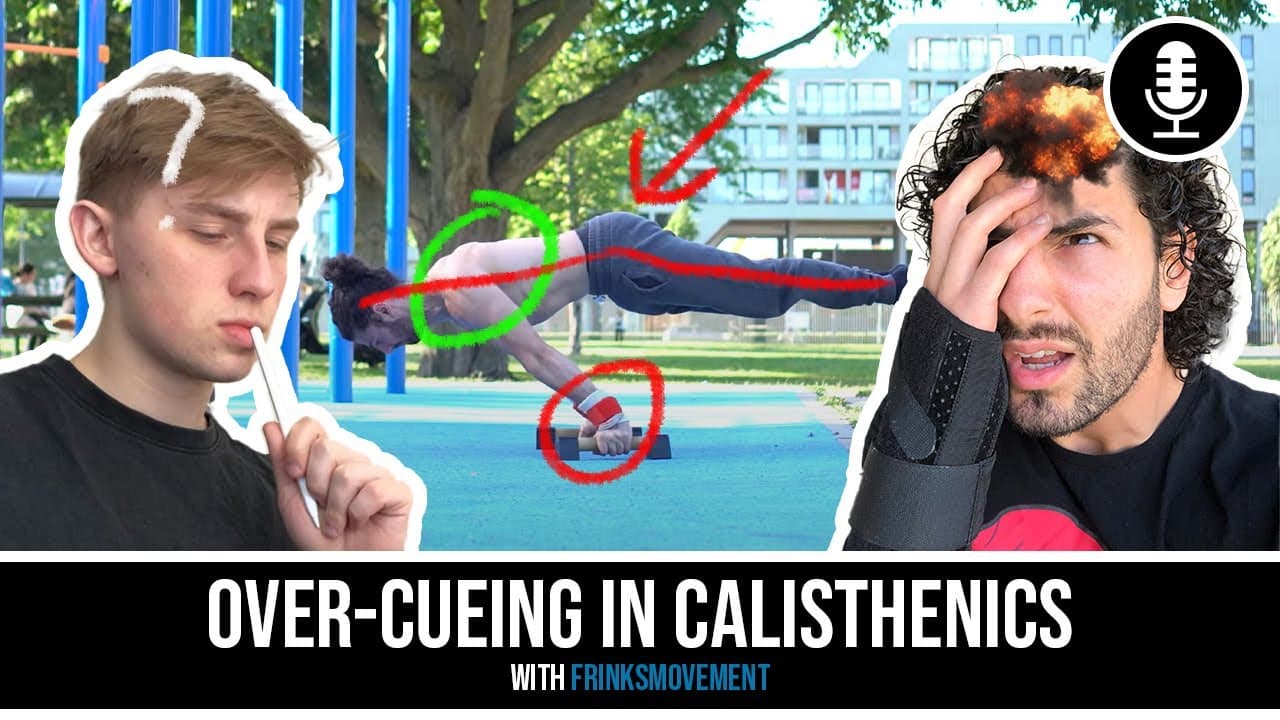

When Ian Barseagle, one of the most polarizing figures in the calisthenics world, accepted an invitation to discuss his training methods on my podcast, the result was not the drama-fueled confrontation that social media might have expected. Instead, what unfolded was a remarkably honest, technically rich conversation between two experienced athletes who disagree on some points, align on others, and share a genuine respect for the craft. Standing 188 centimeters tall and weighing between 92 and 95 kilograms, Ian is a physical outlier in a sport that traditionally favors lighter athletes. His two-set method has attracted both devotees and fierce critics, and I dig into every aspect of it with the analytical rigor of someone who is both a medical doctor and a 14-year calisthenics veteran.
The Two-Set Method Explained
Ian's two-set method is a minimalist training approach rooted in high-intensity, low-volume principles. The concept traces its origins to bodybuilder Mike Mentzer's heavy-duty training philosophy. The method calls for two working sets per exercise, taken to absolute failure, with a rep range of 8 to 15 repetitions. The split is push, rest, pull, legs, two days rest, then repeat. Recovery between sessions for the same muscle group is a minimum of four to five days, sometimes extending to seven or even eight days, particularly when an athlete is first adapting to the method.
Ian is refreshingly honest about the method's place in the training landscape. He rates it approximately 7 out of 10 for strength development and 8 out of 10 for muscle growth, acknowledging that dedicated strength programs and dedicated hypertrophy programs each outperform it in their respective domains. But the combination of solid results in both areas, coupled with extremely short workout times, makes it what Ian calls "a good solid method" that has worked for him and for many of his clients over years of application.
I appreciate the simplicity. One of the method's greatest strengths, we both agree, is that it is nearly impossible to mess up. The instructions are clear: choose a rep range, take sets to failure, do better than last time, rest enough. For beginners and intermediates, this simplicity drives adherence and consistent progress.
The Failure Debate
A significant portion of our conversation centers on the question of training to failure. Ian advocates for true failure in his two-set method, using a tactical approach where the athlete performs non-stop repetitions until close to failure, then takes 2-3 second pauses between final reps to squeeze out additional work. This is not mindless grinding; it is a structured approach to maximizing the stimulus from a minimal number of sets.
I acknowledge that research supports both training to failure and training close to failure for hypertrophy. However, I personally prefer what I call "dynamic reps in reserve," a system where athletes progressively work closer to failure over the course of a training cycle. Early in a cycle, they might stop two reps short of failure. As weeks progress and adaptation occurs, they naturally push closer to failure. This built-in progressive intensity curve reduces the risk of burnout while ensuring that maximal effort is reached at the appropriate time.
We both agree that for beginners, the simplicity of going to failure eliminates the guesswork around effort calibration. Experienced athletes, by contrast, can benefit from the nuance of proximity-to-failure management because they have the self-awareness to accurately gauge their reserves.
Skills and the Two-Set Method: Where It Falls Short
One of the most important clarifications in our conversation comes when Ian explicitly states that the two-set method is not designed for skill training. This is a distinction that has been lost in the social media discourse around his method. Ian confirms he has never claimed that two sets to failure will teach someone a planche or a front lever.
The reasoning is sound. Skills require high volume, moderate intensity, and high frequency, the exact opposite of the two-set method's philosophy. A skill like handstand push-ups, for example, benefits from multiple sets at submaximal intensity performed several times per week. The balance component demands repeated practice that cannot be developed in two all-out sets. Ian even provides a specific example: for an athlete who can do six handstand push-ups, he would recommend eight sets of three with the last set having one to two reps in reserve, performed multiple times per week.
What Ian does claim is that the foundational strength built through the two-set method on weighted pull-ups and weighted dips accelerates skill acquisition once an athlete transitions to specific skill training. I largely agree with this principle while noting that the transfer from weighted exercises to static holds like the planche is less predictable than many athletes assume.
Recovery, Fatigue, and the Limits of Motivation
The conversation takes a fascinating turn when we discuss the factors that determine workout quality beyond the training itself. Ian initially frames poor workouts as the result of "mistakes" in sleep, diet, or life management. I push back gently, preferring to call these factors simply "life" rather than mistakes.
I use a thought experiment to illustrate my point: imagine identical twins performing the same two-set method. If one twin takes a job, even a non-physical job, the added life stress will impair their recovery compared to the twin who can dedicate all their resources to training. This is not a failure of motivation or discipline; it is basic physiology. The body cannot differentiate between training stress and life stress. Both draw from the same recovery pool.
This leads to a broader discussion about burnout and overtraining syndrome, which I note are physiologically similar phenomena. As a medical doctor who experienced this firsthand when I began working clinically at the hospital, I had to fundamentally restructure my training approach. The takeaway for non-professional athletes is critical: programs designed by and for full-time athletes may be inappropriate for people who work demanding jobs, manage families, and navigate the stresses of daily life.
Ian concedes the point but adds his own nuance: the more advanced an athlete becomes, the less room there is for these life factors to interfere without impacting progress. A beginner can make gains despite multiple major disruptions. An elite athlete operating near their ceiling needs everything optimized.
Ian's Planche Journey at 92 Kilograms
Perhaps the most compelling segment of our podcast involves Ian's current pursuit of the planche. At 188 cm and 92+ kg, this is an audacious goal. Ian reports being approximately four and a half months into focused planche training, currently holding a wide planche for about two seconds with slowly improving form. He is being monitored by elite planche athletes, including one who has achieved a 28-second maltese hold.
I offer a specific piece of technical advice: work on the hollow body position. Having recently relearned the planche myself after my own bicep tear, I explain that a rounded upper back with proper protraction and posterior pelvic tilt reduces the lean angle needed, decreasing strain on the wrists, biceps, and shoulders. This means more sets can be performed safely, which is exactly what a large athlete like Ian needs.
Ian, to his credit, accepts the advice fully. He acknowledges that multiple athletes have told him the same thing but that he had not taken it seriously until our conversation. The exchange culminates in a playful but genuine challenge: I want to see Ian perform planche push-ups to a three-second hold on camera, and I promise to fly to wherever he is to shake his hand when it happens.
The Bigger Picture: Respectful Disagreement
What makes this podcast episode stand out is the tone. In a community where reaction videos and call-outs can turn toxic, Ian and I demonstrate that two athletes can disagree on methodology while maintaining mutual respect. Ian addresses the criticism around his claims directly and adjusts his stated timelines based on my input. I challenge claims with evidence while acknowledging the real-world results Ian and his clients have achieved.
Key Takeaways
- •The two-set method is a solid minimalist approach for combined strength and hypertrophy, rated roughly 7/10 for strength and 8/10 for muscle growth by its own advocate
- •Training to failure and training close to failure both produce hypertrophy; the best approach depends on training experience and program context
- •The two-set method is explicitly not designed for skill training; skills require higher volume, lower intensity, and greater frequency
- •Life stress and training stress draw from the same recovery pool; programs must account for total life demands, not just gym volume
- •The more advanced an athlete becomes, the less room there is for recovery disruptions
- •Hollow body positioning in planche training reduces joint stress and enables higher training volume
- •Foundational strength from weighted calisthenics accelerates skill acquisition but transfer to static holds is not perfectly predictable
- •Respectful, evidence-based dialogue between athletes advances the entire community more than social media drama ever could
My conversation with Ian Barseagle is proof that the calisthenics community is maturing. When athletes can sit across from each other, disagree openly, learn from each other, and walk away with adjusted perspectives, the entire sport benefits. Ian's two-set method is not perfect, and he is the first to say so. But it is a legitimate training approach with real results, and the willingness to discuss its limitations openly is exactly what the community needs more of.