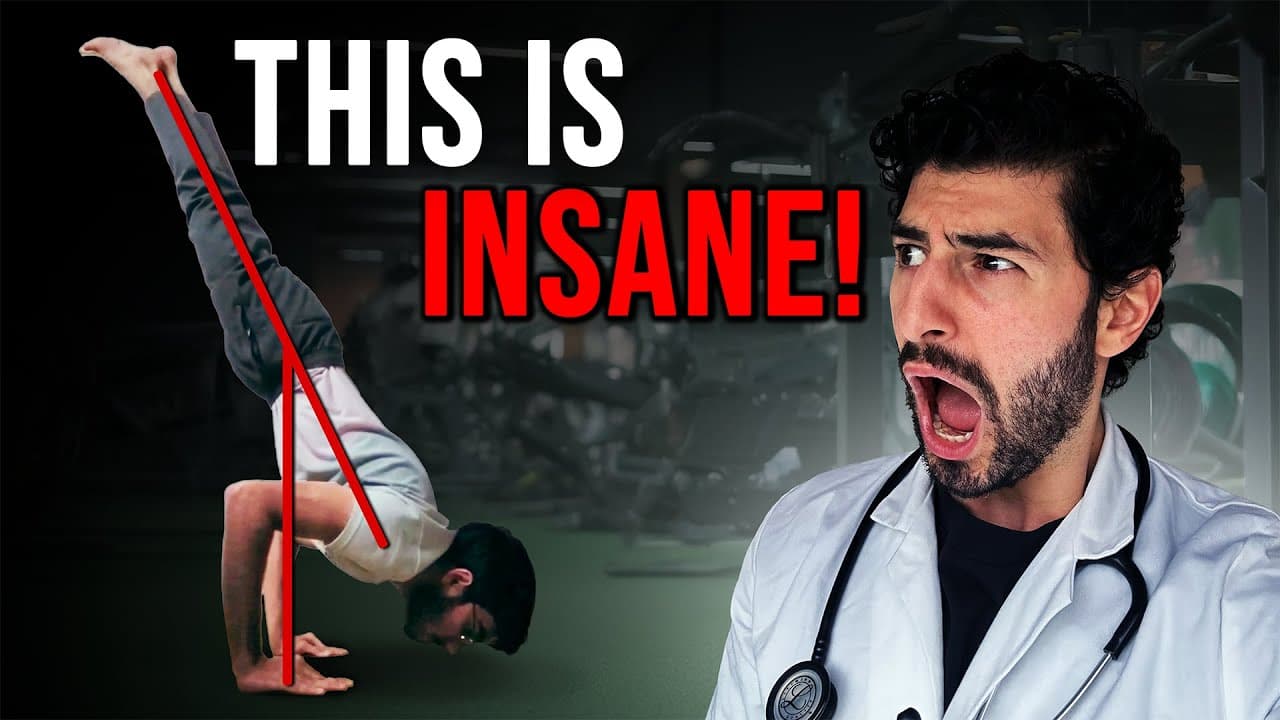

When two calisthenics coaches with academic backgrounds and over a decade of experience each sit down to compare notes, the conversation that unfolds is either going to be a heated debate or a revelation. In my case, as a medical doctor with over 15 years of calisthenics experience, sitting down with Denis from Sthenics, a pharmaceutical scientist and elite-level coach based in Vienna, it was overwhelmingly the latter. Despite having never collaborated before, Denis and I independently arrived at nearly identical programming philosophies through the same evidence-based methodology. The resulting podcast conversation is a masterclass in how to structure calisthenics training for long-term progress without destroying your body in the process.
Intuitive Training Versus Structured Programming
The first major topic tackled the calisthenics community's oldest debate: should athletes train intuitively, following how they feel each day, or follow a structured program with periodized blocks, prescribed volumes, and measurable progression? I played devil's advocate for intuitive training, arguing that rigid programming can lead to missed opportunities when an athlete feels ready for a different stimulus than what the program prescribes.
Denis countered with a nuanced perspective. He acknowledges that intuitive training can work, but only for a very specific subset of athletes: those who are genetically gifted enough to recover from almost anything, or those who have accumulated years of structured training experience and internalized good programming principles so deeply that their intuition is essentially a subconscious data-driven algorithm. For everyone else, and that means the vast majority of athletes, intuitive training is motivation-based training in disguise. Athletes default to what they enjoy and what they are already good at, neglecting weaknesses and ignoring recovery signals until injury forces a correction.
We both agreed that the best approach combines structure with autoregulation. A well-designed program provides the framework of periodized blocks, prescribed volume ranges, and measurable progression markers, while allowing athletes to make day-to-day adjustments within defined parameters. Denis described this as taking autoregulation on steroids. I resonated strongly with this framing, noting that my own programming follows the same principle.
The clincher came from an unexpected source: Olympic swimming. Denis shared his exchange with Cameron McEvoy, the 50-meter freestyle gold medalist, who completely overhauled his training methodology based on strength science principles rather than the traditional swim-more-laps approach that dominated the sport. The result was a transformation from Olympic underdog to gold medalist and world record holder, all because he replaced tradition-based training with evidence-based periodization.
Block Periodization with Daily Undulation
Both of us, independently, settled on the same periodization model: block periodization with daily undulating elements. This means training is organized into 4 to 8 week blocks (mesocycles) that progress from higher volume and lower intensity in the early blocks to lower volume and higher intensity as the athlete approaches a testing or peaking phase. Within each block, training days alternate between higher-rep and lower-rep sessions for the same movement patterns, providing varied stimuli while maintaining exposure to different intensity ranges.
Denis and I both use weighted calisthenics as the base for programming because it provides objective, measurable data. A weighted dip with 60 kilograms is unambiguous. You either did it or you did not. This objectivity allows coaches to track progress, identify trends, and make informed decisions about volume adjustments. We were both visibly amused to discover we had arrived at this identical methodology through independent research, primarily by studying powerlifting periodization and adapting it to the unique demands of calisthenics.
The underlying principle is straightforward: build a bigger glass, then fill it with water. The glass represents the athlete's capacity, built through volume phases with moderate intensity. The water represents the intensity that fills that capacity during peaking phases. A bigger glass holds more water. More accumulated volume supports higher eventual intensities.
The Skill Work Puzzle: Balancing Specificity and Sustainability
Where our conversation truly broke new ground was in the discussion of skill work volume, the single most complex programming challenge in calisthenics. Unlike weighted exercises where volume can be precisely quantified in sets, reps, and kilograms, skill work presents a cascade of complications. Central nervous system fatigue rather than muscular fatigue is the primary limiter for most athletes. Beginners physically cannot generate enough force to fatigue their muscles during skill attempts, meaning their training volume has a completely different fatigue profile than that of advanced athletes.
Denis introduced his approach to skill volume landmarks, adapted from Mike Israetel's hypertrophy-focused volume framework but modified for skill-specific training. For planche, he estimates maintenance volume at approximately 6 sets per week, minimum effective volume at 8 sets per week, maximum adaptive volume at 12 to 24 sets per week, and maximum recoverable volume at 30-plus sets per week. These numbers shift depending on whether the athlete is in a volume phase with higher sets and shorter holds, or an intensity phase with fewer sets and longer holds.
The critical insight is that not every skill set counts as effective volume. In a typical session of 8 sets of 2-second holds, the first 4 to 5 sets might be so easy that they serve primarily as neurological practice rather than genuine strength stimulus. Only the last 3 to 4 sets approach the intensity threshold where they drive adaptation. Denis advocates counting skill volume at roughly half face value when sets have large margins, meaning an 8-set session might only represent 4 sets of effective volume.
Why Specificity Is Both the Best and Most Dangerous Principle
We both addressed the paradox of specificity in calisthenics. The most important principle in strength training is specificity: to get better at planche, do planche. To improve front lever, train front lever. This is factually the best way to train. The problem is that most people cannot survive it.
The connective tissue demands of movements like planche and maltese are so extreme that the front deltoids might be able to handle the volume, but the biceps tendons, wrists, and shoulder joints cannot. This mismatch between muscular capacity and connective tissue tolerance is the primary reason for the epidemic of tendon injuries in calisthenics. Athletes push skill-specific volume to build strength in their target muscles, and their tendons simply cannot keep up.
The solution we both converge on is using weighted calisthenics to develop the primary muscle groups, such as military press and weighted dips for front deltoid strength, while keeping skill work focused on technique, activation patterns, and progressive exposure to sport-specific positions. As Denis explains, you make the muscles bigger and stronger through exercises that generate minimal joint stress, then gradually channel that strength into increasingly specific skill positions as the connective tissue adapts over months and years.
Frequency, CNS Fatigue, and the Long Game
On training frequency for skills, Denis recommends two sessions per week for most athletes, potentially three if activation patterns need additional practice. This is notably lower than what many popular calisthenics programs prescribe. The reasoning is rooted in joint and tendon recovery rather than muscular recovery. While the central nervous system can adapt to higher frequencies relatively quickly, the connective tissue cannot, and it is connective tissue failure, not muscular failure, that ends calisthenics careers.
I shared my observations from training alongside elite athletes like Andry Strong and Viktor Kamenov, both of whom train with volumes and frequencies that would destroy most people. The key distinction is that these athletes have built their recovery capacity over many years and possess genetic gifts that allow them to tolerate extraordinary training loads. Coaching average athletes using elite athlete methods is not just ineffective; it is actively harmful. As Denis pointed out, gifted athletes often make poor coaches precisely because they cannot relate to the limitations that normal trainees face.
Key Takeaways
- •Structured programming with autoregulation consistently outperforms pure intuitive training for the vast majority of calisthenics athletes.
- •Block periodization with daily undulating elements, borrowed from powerlifting science, provides the optimal framework for calisthenics strength development.
- •Weighted calisthenics serves as the measurable foundation of programming, while skill work follows its own rhythm based on technical progression and connective tissue tolerance.
- •Not every skill set counts as effective volume. Early sets with large margins serve neurological practice, while only the last few sets per session drive genuine adaptation.
- •Specificity is the most effective training principle but also the most dangerous when connective tissue cannot match muscular capacity. Build strength through safe exercises first, then channel it into skill-specific positions.
- •Training frequency for skills should be limited to 2-3 sessions per week for most athletes, with connective tissue recovery being the primary constraint.
- •Elite athletes should not be used as programming templates. Their genetic recovery capacity and years of accumulated tissue tolerance make their methods unsuitable for most trainees.
The fact that two coaches from different countries, different academic backgrounds, and different coaching lineages independently developed nearly identical programming systems is not a coincidence. It is evidence that the science of training adaptation, when honestly applied without ego or tradition, converges on the same answers. For calisthenics athletes looking for a sustainable path to advanced skills, the message from both Denis and me is clear: be patient, be structured, measure everything, and above all, respect your tendons.