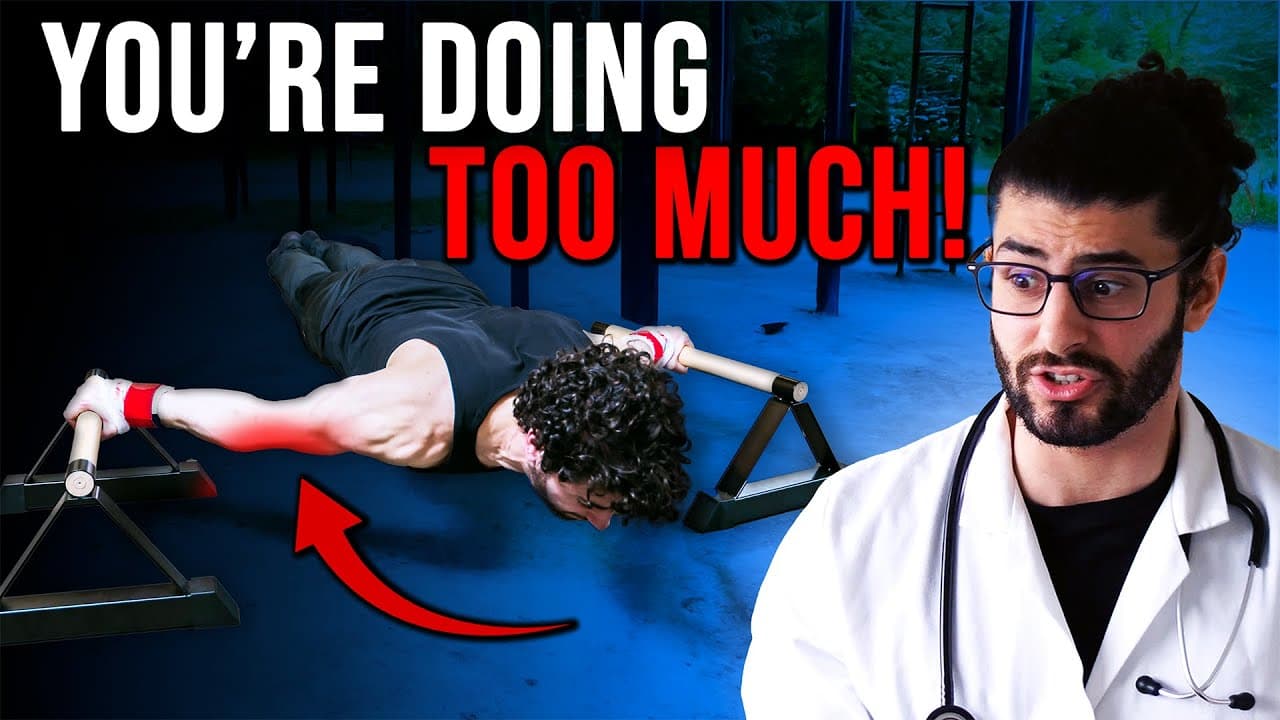

Tendons are the silent workhorses of the human body, and for calisthenics athletes, they are also the most common source of career-ending injuries. Unlike muscles, tendons do not give you delayed onset soreness. They do not send warning signals to the brain before they fail. One day everything feels fine, and the next, something pops. I sat down with Professor Keith Baar, one of the world's leading tendon researchers from UC Davis, to develop an evidence-based protocol for building bulletproof tendons. As a medical doctor and a calisthenics athlete with over 15 years of experience, this conversation may be the most important resource I have ever produced for calisthenics athletes concerned about connective tissue health.
Tendons Adapt Faster Than You Think
One of the most surprising revelations from Professor Baar's research demolishes a long-held belief in sports science: the idea that tendons adapt slowly. For years, coaches and practitioners assumed that tendons lag far behind muscles in their adaptive response to training. Professor Baar's lab data tells a completely different story. Tendons actually adapt faster than muscle tissue. The flip side is equally dramatic: when immobilized for just three days, a tendon can lose 15 to 20 percent of its collagen content. What takes 3 days to lose requires approximately 8 weeks to rebuild.
This finding has profound implications for injury management. The old protocol of resting, immobilizing, and waiting for healing is not just outdated; it actively makes the problem worse. Every day spent immobilized is a day of collagen degradation that will take weeks to reverse.
The 10-Minute Rule: Optimal Loading for Tendon Growth
Professor Baar's lab discovered something remarkable using engineered ligaments that they could exercise in controlled conditions. When they stretched these tissues continuously for 24 hours, the collagen production was decent. But when they applied just 10 minutes of load followed by 6 to 8 hours of rest, then repeated the cycle, they saw double the increase in collagen. The cells within tendons need only about 10 minutes to receive their maximum anabolic signal. After that threshold, additional loading does not increase the growth signal but does increase wear and tear on the tissue.
Even more striking was the comparison between isometric holds and dynamic repetitions. Four 30-second isometric holds over an 8-minute window produced a stronger, bigger tendon. The same total time under tension performed as dynamic repetitions produced a bigger tendon with no increase in strength, and its stiffness actually decreased slightly. The dynamic movements introduced jerk, the rapid changes in acceleration that generate catabolic signals and tissue breakdown. Isometrics delivered the anabolic signal with minimal damage.
Jerk: The Hidden Enemy of Connective Tissue
Professor Baar introduced a concept that every calisthenics athlete needs to understand: jerk. In physics, jerk is the rate of change of acceleration. In practical terms, it is the sudden snap in direction or load that puts extreme stress on tendons and ligaments. Tennis elbow comes from the backhand jerk. Golfer's elbow from the swing-through jerk. Jumper's knee from landing impact. And in calisthenics, jerk occurs every time an athlete transitions rapidly between directions during dynamic movements.
This explains why static calisthenics movements, which Professor Baar actually found less concerning than dynamic or weighted movements, are paradoxically both the safest and most beneficial for tendon health. The caveat is that athletes must progress gradually into these positions. The planche, maltese, and front lever all place enormous strain on tendons, but when approached through slow, methodical progression, they build resilience rather than destroy tissue.
My own experience validates this science painfully well. I suffered a 50 percent distal biceps tear during a maltese hold, a movement I had warned others about on a public podcast just a year earlier. Professor Baar explained that research on 890 tendon rupture cases found that every single one showed pre-existing degeneration. There is no such thing as a perfectly healthy tendon that just ruptures. The damage accumulates silently, and when fatigue compromises the stronger tissue that normally shields the weakened area, the tear occurs.
The Practical Protocol for Calisthenics Athletes
Based on the research, Professor Baar and I outlined a practical tendon health protocol specifically designed for calisthenics athletes. The protocol calls for one additional session per day, ideally in the morning, separate from regular training. Athletes should perform light variations of their primary movements, using approximately 50 percent of body weight as maximum load. For planche athletes, this might mean lying prone with dumbbells in the planche position without actually lifting off the ground, just feeling tension through the biceps and deltoid tendons.
The loading parameters are straightforward. For healthy athletes, perform holds of about 10 seconds each across a total active window of 10 minutes. For athletes recovering from injury or with a history of tendon issues, longer holds of 30 seconds are recommended for the first four weeks before transitioning to shorter holds. The rest between sets counts toward the total 10-minute window. Different positions can be cycled through to target multiple tendons: rotator cuff, distal biceps, proximal biceps, and anterior deltoid being the primary concerns for calisthenics athletes.
Regular sport-specific training provides the higher-intensity dynamic stimulus that builds tendon stiffness through cross-linking. The morning anabolic sessions build collagen volume. Together, they create an additive effect, exactly as demonstrated in a climbing study where combining heavy max hangs with light partial-weight hangs produced nearly double the grip strength improvement of either method alone.
Nutrition: Collagen, Vitamin C, and Leucine
Professor Baar emphasized that mechanical loading accounts for approximately 95 percent of the tendon adaptation stimulus, with nutrition contributing the remaining 2 to 5 percent. That said, when the goal is maximizing connective tissue resilience, every percentage point matters.
The nutritional protocol is simple: 5 to 10 grams of hydrolyzed collagen combined with 50 to 250 milligrams of vitamin C, taken 30 to 60 minutes before the anabolic loading session. Vitamin C is essential because the enzyme responsible for exporting collagen from cells into the tendon matrix requires it as a cofactor. Morning levels of vitamin C tend to be depleted, making pre-training supplementation particularly important.
For maximum benefit, combining hydrolyzed collagen with a leucine-rich protein source like whey protein appears to be the optimal approach. Professor Baar's research showed that the mTOR pathway in tendon cells responds to leucine, meaning that the amino acid signals typically associated with muscle protein synthesis also drive collagen synthesis. A practical combination would be approximately 20 grams of whey protein with 10 grams of hydrolyzed collagen and a handful of strawberries or a splash of orange juice.
Injury Rehabilitation: Load Early, Load Often
Perhaps the most paradigm-shifting advice concerns injury rehabilitation. Whether dealing with a partial tear, a full tear, or a post-surgical repair, Professor Baar advocates loading the tissue on day one. This does not mean heavy training. It means gentle isometric loading at a level where the athlete feels tension but no pain. The technique uses what he calls low-jerk isometrics: slowly applying force over 3 to 5 seconds, holding for up to 30 seconds, then slowly releasing over 3 to 5 seconds.
Professor Baar compares the rehabilitation protocol to a course of antibiotics. Most people feel dramatically better within one to two weeks, sometimes after just the first session. But the course must be completed. The recommended duration is eight weeks of daily isometric loading, after which maintenance work of once or twice per week is sufficient. Abandoning the protocol early because the pain has resolved is the most common mistake and the primary reason injuries recur.
This approach aligns beautifully with the biopsychosocial model of pain that I always highlight. Early movement after injury teaches the brain that the tissue can handle load, reducing central inhibition and preventing the development of chronic pain patterns. Immobilization does the opposite: it reinforces fear, reduces tissue quality, and prolongs recovery.
Key Takeaways
- •Tendons adapt faster than muscles but also degrade faster during immobilization, losing up to 20 percent of collagen in just three days.
- •The optimal tendon loading stimulus is 10 minutes of total active time, with isometric holds being superior to dynamic movements for building collagen.
- •Jerk, the rapid change in acceleration, is the primary driver of connective tissue injury. Static holds minimize jerk while maximizing the anabolic signal.
- •A daily 10-minute morning session of light isometric holds at around 50 percent body weight provides a powerful protective stimulus without adding meaningful fatigue.
- •Supplement with 5-10 grams of hydrolyzed collagen plus vitamin C before tendon loading sessions. Combine with whey protein for maximum collagen synthesis.
- •After injury, begin gentle isometric loading immediately. Complete an 8-week rehabilitation course even if symptoms resolve earlier.
- •Never immobilize a non-surgical tendon injury. The research is unambiguous: early loading produces better outcomes than rest.
This conversation with Professor Baar represents a genuine breakthrough in how calisthenics athletes can approach tendon health. The protocol is simple, evidence-based, and requires no special equipment. For a sport where tendon injuries end more careers than any other factor, this knowledge is not just useful. It is essential.